
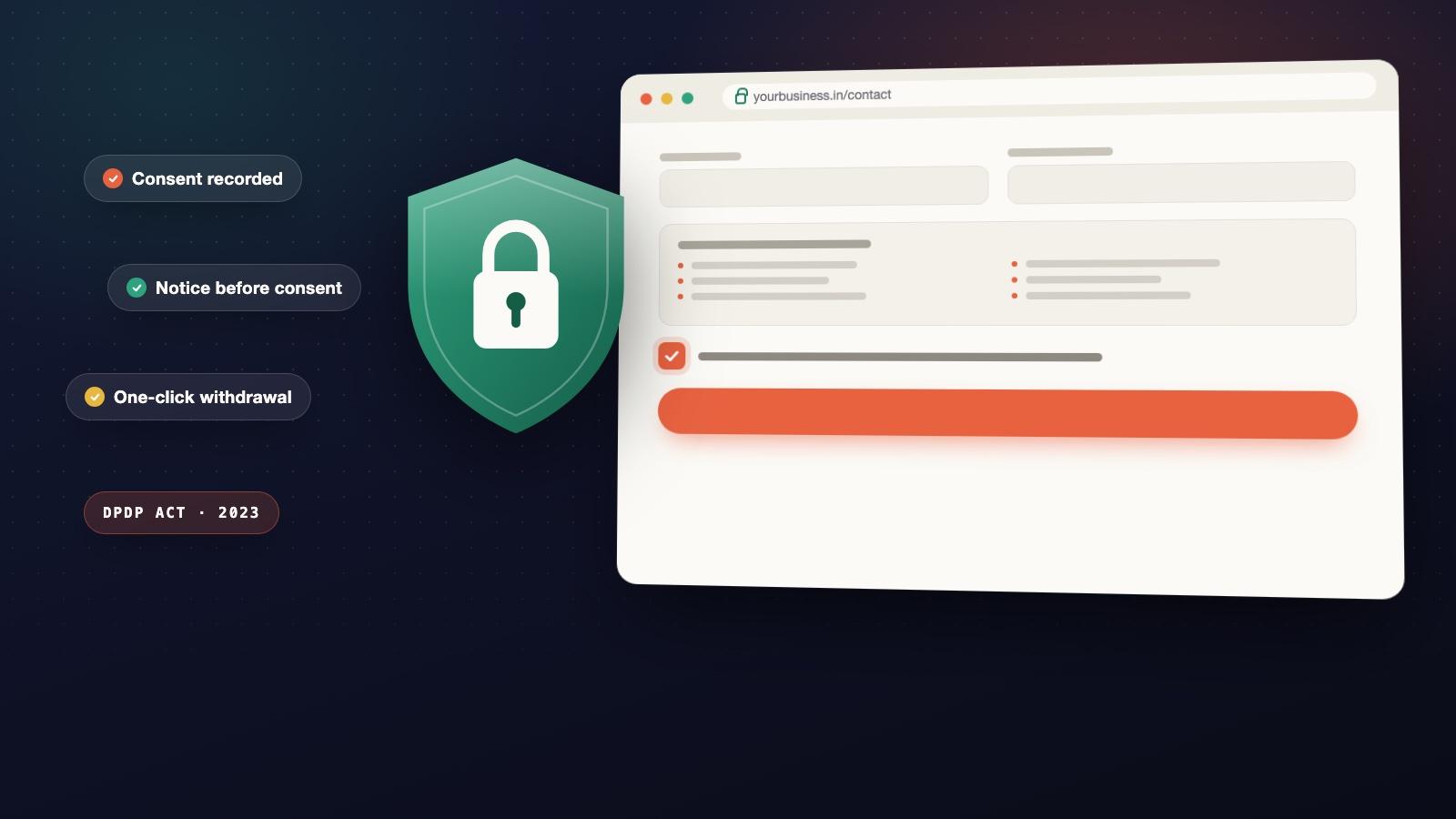
Is your website DPDP-ready? What the DPDP Act demands before 13 May 2027
Your website has six months to get DPDP-ready.
From 13 May 2027, the contact form on your homepage becomes a legal obligation. Notice, consent, withdrawal, rights requests and proof — your website has to do all of it, and most Indian business websites do none of it today. We build websites that do.
The short answer
India's Digital Personal Data Protection Act, 2023 and the DPDP Rules, 2025 apply to every business that collects personal data from people in India — and your website is almost certainly where you collect the most of it. The core obligations take effect on 13 May 2027. From that date, a contact form with no notice, a pre-ticked or missing consent box, Google Analytics firing on page load, and no way for a visitor to withdraw consent or ask what you hold is a breach of the Act. Penalties run up to ₹250 crore. This is not a privacy-policy problem you can solve with a template. It is a website problem — forms, scripts, records and workflows — and it is exactly what we build. If you want it fixed rather than explained, skip to the end and book the audit.
The DPDP Act in plain language
Parliament passed the Act in August 2023. The Ministry of Electronics and IT notified the DPDP Rules on 13 November 2025 and set a phased start: the Data Protection Board of India came into being immediately, Consent Manager registration opened on 13 November 2026, and the duties that matter to your business — notice, consent, security, breach reporting, retention, rights and grievance redressal — apply from 13 May 2027. The Act calls your business a Data Fiduciary and each visitor a Data Principal. It covers personal data collected digitally, which means everything typed into your website. There is no blanket exemption for being a small business, an agency or a B2B firm. If a person can fill in their name and email on your site, the Act applies to you.
The numbers every business owner should know
0 May 2027
core DPDP duties take effect for every business
₹0 Cr
maximum penalty for failing to protect personal data
0 hrs
to send the Board a detailed report after a data breach
0 days
the most you can take to resolve a privacy grievance
Why your website is where this bites first
Look at what your website quietly collects. The enquiry form takes names, emails and phone numbers. The WhatsApp or chat widget logs conversations. The newsletter pop-up builds a mailing list. The careers page collects CVs full of personal detail. Google Analytics and the Meta pixel set identifiers on every visitor and send them to third parties. A checkout stores addresses and order history. Every one of these is processing personal data, and under the DPDP Act every one needs a lawful basis — for almost all of them, that means consent obtained the way the Act prescribes. Your website is also where a regulator, a competitor or an unhappy customer will look first, because it is public. A missing consent box is visible to anyone in ten seconds.
What a DPDP-compliant website must do
Notice before consent
Before you ask for consent, a notice that stands on its own must list the exact personal data you collect and the specific purpose for each — and tell people how to withdraw, exercise their rights and complain to the Board (Section 5, Rule 3).
Real, specific consent
Consent must be free, specific, informed, unconditional and unambiguous, given by a clear affirmative action. An unticked box the visitor ticks. Not a pre-ticked one, not 'by submitting you agree', and not marketing bundled into an enquiry (Section 6(1)).
Withdrawal as easy as consent
If consent took one tick and a click, withdrawing it cannot take a phone call and a notarised letter. Your website needs a withdrawal route as easy as the form itself (Section 6(4)).
A way to exercise rights
Visitors can ask for a summary of their data, correction, erasure, or to nominate someone to act for them. Your site must publish how, and you must act on it (Sections 11–14, Rule 14).
A published grievance contact
A named person or Data Protection Officer who answers questions about processing, shown prominently on the website — and a grievance process that responds within 90 days at most (Section 8, Rules 9 and 14).
Proof you did it right
If consent is ever questioned, the burden is on you to prove the notice was given and consent was received. That means storing when each person consented and which version of the notice they saw (Section 6(10)).
Analytics and pixels on consent
Analytics and ad pixels process personal data. Unless a narrow exception applies, they should not fire until the visitor agrees — with 'Reject' as easy as 'Accept' and a way to change the choice later.
Retention and erasure
Erase personal data once its purpose is served or consent is withdrawn, and make your processors do the same — while keeping security logs for at least one year, as the Rules require (Section 8(7), Rule 8).
Security and breach readiness
Reasonable safeguards — encryption, access control, logging — and a plan to tell affected people and the Board without delay, with a detailed report within 72 hours (Section 8(5)–(6), Rules 6 and 7).
What non-compliance can actually cost
The Act's schedule sets maximum penalties per breach: up to ₹250 crore for failing to take reasonable security safeguards, up to ₹200 crore for failing to report a breach and for breaching the obligations around children's data, and up to ₹50 crore for breaching any other provision — which is where a missing notice, invalid consent or an ignored withdrawal falls. The Board scales penalties to how serious the breach was, so a small firm will not be fined like a bank. But any visitor can file a complaint with the Data Protection Board of India online once they have tried your grievance process, and an inquiry costs you management time, legal fees and reputation regardless of the final figure. There is a sharper commercial cost too. Larger clients answer to the same Act for the data they share with vendors, so expect DPDP questions in procurement and vendor checks. If your website visibly fails the basics, you can lose the contract before anyone mentions a penalty.
Why a privacy-policy template will not save you
The most common response we see is to download a privacy policy, paste it into the footer and call it done. It does not work, because DPDP compliance is about what your website does, not what a document says. A template policy promising consent sits above a form that never asks for it. It promises you honour withdrawal, but there is no way to withdraw. It says analytics runs on consent, but Google Analytics loads on every page view. It names a grievance officer who does not exist. That gap — between the policy and the actual behaviour of your forms and scripts — is precisely what a complaint will expose. The fix is engineering: forms, consent records, script loading, request workflows and an admin view your team actually uses. That is website development work, and it is what we do every day.
How we make your website DPDP-compliant
01
Audit
We map every place your website touches personal data — each form, widget, pixel, analytics tag, integration and processor — and give you a plain-English gap report against the Act and Rules.
02
Fix the forms
Clear standalone notices, unticked purpose-specific consent, data minimisation, and a stored consent record — timestamp and notice version — for every submission.
03
Gate the tracking
Analytics, Meta and Google Ads pixels load only after consent, using consent mode where the platform supports it, with an equal-weight Accept/Reject banner and a settings link to change the choice.
04
Build the rights workflow
A withdrawal and rights-request form, routed to your grievance officer, logged in your admin with response deadlines, so nothing slips past 90 days.
05
Publish the notices
A privacy notice written for your actual data flows — processors, retention, rights, grievance contact and Board complaints — kept in step with your form notices, plus terms and conditions.
06
Hand over and train
Your team gets the admin view, a one-page process for requests and breaches, and a site that stays compliant as you add forms — not a one-off patch.
We did it to our own website first
Before offering this to clients, we rebuilt markage.in to the standard we are describing. Open our contact page and you will see an itemised notice and an unticked consent box; every enquiry is stored with the time of consent and the notice version shown. Our privacy notice lists every processor we use, how long we keep data and how to complain to the Board, and includes a one-step form to withdraw consent or exercise any right. Google Analytics does not load until you click Accept, and 'Cookie settings' in the footer lets you change your mind. It took engineering, not paperwork — and it is the same build we deliver for clients, whether your site runs on WordPress, Shopify, Webflow or custom code.
Planning a new website anyway? Build compliance in from day one
If your website is due for a redesign, the cheapest moment to become DPDP-compliant is now, during the build, rather than retrofitting later. Every website we build ships with compliant forms, consent records, consent-gated analytics, a rights-request workflow and accurate privacy and terms pages as standard — alongside the speed, SEO and conversion work we are known for. You get a site that wins enquiries and stands up to scrutiny, from one team, on one timeline.
Do not leave this to April 2027
Six months sounds like plenty. It is not. A focused compliance retrofit takes us two to four weeks; a new website takes four to eight. Add time for your legal review, internal sign-off and the content only you can provide, and the comfortable window closes around February. Every agency and developer in India will be fielding the same request in the final weeks, and rushed compliance work is where mistakes happen. The businesses that move this quarter get it done properly, at a calm pace, with time to fix what the audit uncovers. Start with the free audit: we review your website and send you a plain-language list of what fails the DPDP Act and what it will take to fix.
DPDP Act and your website — FAQs
Can't find what you're looking for? Email hello@markage.in and we'll reply within 24 hours.
Yes, if it collects personal data from people in India — a name and email in a contact form is enough. The Act has no blanket exemption for small businesses, and the core obligations apply from 13 May 2027.
Let's talk
Find out where your website fails the DPDP Act — free.
Send us your website address. Within three business days we will send a plain-language audit of every form, tracker and notice that falls short of the DPDP Act, with a fixed-price quote to fix it — or a new compliant website built from day one. No obligation.
Keep reading

Website development in Vidarbha: your site's job is to survive being checked
Web · Web Development
Website development in Vidarbha: your site's job is to survive being checked
Across Vidarbha's eleven districts, most businesses don't need a website to find customers — they need one to survive the buyer who googles their firm name before placing an order. Here is what that actually requires, district by district, and what it costs in 2026.

How to choose a white-label marketing partner (and when not to)
White-label · Agency
How to choose a white-label marketing partner (and when not to)
White-label delivery fixes an agency margin problem or creates a quality problem, depending entirely on how you pick. Here is the difference between white-label, offshore and freelance, the five questions that separate a partner from a reseller, and the honest timezone maths nobody publishes.
Website or app? A 2026 build guide for Nagpur businesses
Web · App Development
Website or app? A 2026 build guide for Nagpur businesses
Most businesses asking for an app need a better website first. Here is how to tell which one you actually need, what each costs in Nagpur and across India in 2026, and the questions that separate a serious development partner from a template shop.